Home alone
Dog Alone While You Work: Schedules That Help
Quick answer
A dog alone while you work needs a plan built around training and cover, not the other way round. Pick the closest of four templates: work from home, hybrid, full-time office, or shifts. A dog in training should not be left past its current ladder level, so cover the hours it can't yet manage.
- The plan fails if your dog still has to be alone for nine hours on Tuesday. Build the week around training and cover.
- Four templates: work from home, hybrid, full-time office, and shifts or two adults. Each has a bad-day version.
- UK charities say a relaxed adult dog should be left no more than about four hours. That is a guideline, not a legal limit.
- Returning to the office? Start rebuilding time alone several weeks before the date.
A dog alone while you work needs more than good intentions. The plan fails if your dog still has to be alone for nine hours on Tuesday. So build the week around training and cover, not the other way round.
The four-hour reality for a dog alone while you work
Dogs Trust and RSPCA, two UK charities, say a relaxed adult dog should be left alone for no more than about four hours, and puppies for much less. Many US workdays are longer, and this is a UK guideline, not a legal limit.
What matters most for a dog in training: it should not be left past its current ladder level at all. The honest options for a long workday are cover (family, sitter, walker, daycare), a flexible stretch from work, a dog-friendly office, or a trusted neighbor.
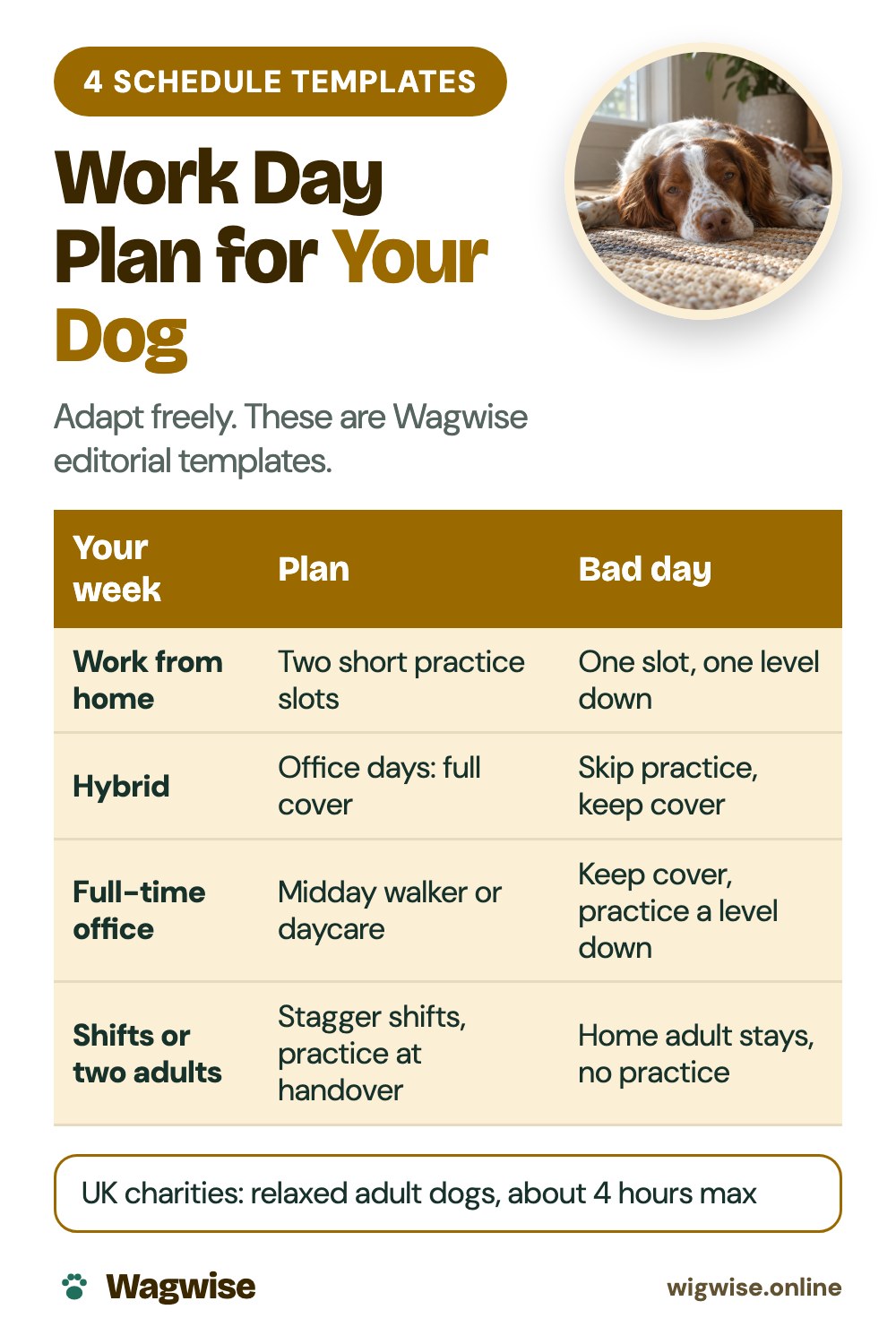
Four schedule templates (editorial: adapt freely)
| Your week | Plan | Bad day |
|---|---|---|
| A. Work from home | Morning walk and toilet, back 30 minutes before the first practice. Two short practice slots, such as after lunch and late afternoon. You are home the rest of the day. | One slot, one level down |
| B. Hybrid | Office days: full cover (partner, sitter, walker or daycare). Home days: two practice slots and long rests. | Skip practice, keep the cover |
| C. Full-time office | A midday walker or daycare for the hours your dog can’t yet manage, or a flexible start. Practice evenings and weekends. | Keep the cover, log it, practice a level down |
| D. Shifts or two adults | Stagger shifts so someone is home. Do a short practice at the changeover. | The home adult stays, no practice |
What is the training fortnight?
If you can, plan leave or a flexible stretch for the first one to two weeks. Use evenings and weekends for short practice, and keep your dog’s other hours covered. It’s an editorial suggestion, not a rule.
A short script for your boss: “I’m training my dog to be comfortable alone, on a plan from my vet. For the next few weeks, a flexible start, two days working from home or a short midday break would help me do it safely.” Keep it short, specific and with an end date.
Returning to the office with a dog
If you’re heading back after months at home, start rebuilding your dog’s time alone several weeks before the date. In a UK survey of 1,807 dogs, about 9.9 percent of dogs that were being left alone again by October had developed signs after being clear in February, and dogs whose time alone dropped most were at higher risk.
That study was owner-reported, self-selected and observational, with no clinical diagnoses. It tells us to plan ahead, not that a plan prevents it.
A gentle lead-in looks like this:
- Weeks before: short, normal outings, a settle on a mat, calm cues.
- Days before: practice your real routine, including the walker.
- Never go straight from being home all day to a full workday alone.
No cover? Be honest
Options include a dog-friendly workplace, work-from-home days, sitter or neighbor swaps, daycare for a trial period, reduced hours for a few weeks, and your vet and behaviorist as early as possible. Free or low-cost help counts: a neighbor swap, a friend for an afternoon, or a volunteer walker.
For more on filling the gaps, see covering the hours your dog can’t yet be alone and a four-week plan. The Wagwise home alone guide has a cover plan and weekly schedule sheet. It is general education and can’t replace your vet.
Frequently asked questions
How long can I leave my dog alone while I work?
Dogs Trust and RSPCA, two UK charities, say a relaxed adult dog should be left no more than about four hours, and puppies for much less. Many US workdays are longer, so this is a guideline, not a legal limit.
What is the training fortnight?
If you can, plan leave or a flexible stretch for the first one to two weeks. Use evenings and weekends for short practice and keep your dog's other hours covered. It's an editorial suggestion, not a rule.
What should I say to my boss?
Keep it short and specific, with an end date: you're training your dog to be comfortable alone on a plan from your vet, and a flexible start, two days working from home or a short midday break would help for the next few weeks.
What if I'm going back to the office after working from home?
Start rebuilding your dog's time alone several weeks before the date, with short, normal outings. Never go straight from being home all day to a full workday alone.
More Wagwise guides for dog owners
 Stop Puppy BitingA gentle 4-week plan to stop the nipping and get through teething.$17 · instant PDFSee the guide →
 Get Rid of Dog Pee SmellRemove urine odor for good, then stop the accidents with a 14-day reset.$17 · instant PDFSee the guide →
 Stop Dog BarkingA quiz finds why your dog barks, then a plan made for that reason.$17 · instant PDFSee the guide →
 Help Your Itchy DogTrack triggers, soothe skin safely and know when to see the vet.$17 · instant PDFSee the guide →
 House-Train Your PuppyA kind 4-week plan with a schedule by age, a night plan and printable trackers.$17 · instant PDFSee the guide →
 Stop Leash PullingA 4-week force-free plan for calmer walks and a loose leash.$17 · instant PDFSee the guide →
 Puppy Sleeps Through the NightA realistic, age-by-age plan for calmer nights, without cry-it-out or crate fights.$17 · instant PDFSee the guide →
 Less Dog Hair, Less SmellA 4-week brushing, bath and home routine for a calmer-smelling house.$17 · instant PDFSee the guide →
Want all four? Get the complete library for $49.
Sources
This article is general education, not veterinary advice. It does not replace an examination by your vet or help from a qualified behaviourist.